- Corporate
- Our Solutions
-
Media
- Product Brochures
-
Press News
- Simsoft Participated in World Defense Show (WDS) 2026 in Riyadh
- Simsoft Showcased Next-Generation Simulation and Training Technologies at EDEX 2025
- “Gaming Panel in the Second Century” Sheds Light on the Digital Future
- We are on the Next Sosyal Platform!
- Simsoft at IDEF 2025: A Strong Future with Local Technology
- We Are Pleased to Announce
- We Have Secured Our Place Among Turkey's Top 500 IT Companies
- Our President Mr. Recep Tayyip Erdoğan Honored Us With His Visit To Our Stand During The EFES 2024 Exercise.
- TÜBİTAK BİLGEM Personnel visited our SIMMER New Generation Simulation Development, Training and Test Center
- SİMMER from SSB International Cooperation Department Personnel Visited Our Facility
- KTU Students visited our SIMMER - New Generation Simulator Production, Training and Test Center
- Opening Ceremony of our SIMMER Facility
- We are happy and proud to celebrate the 18th anniversary of our foundation!
- ASO 60th Foundation Year Awards "International Project" Award Won by Simsoft
- We Successfully Completed DIMDEX 2024
- SASAD New Office Visit
- CMMI Level3
- World Defense Show 2024 Exhibition Begins
- We Explained Our Simulation, Simulator and Augmented Reality Technologies to the Commanders of the Future
- Simsoft Receives the Award for the Female Entrepreneur Company with the Fastest Increase in Exports
- We were in Karachi Pakistan for IDEAS 2022
- Great Interest to Our Stand at SAHA EXPO 2022
- ICDDA 2022 - 5th Industrial Cooperation Days in Defense and Aerospace
- Let's Meet At ICDDA 2022
- Simsoft EFES Exercise in Exhibition Area
- We Celebrated Simsoft's 16th Foundation Anniversary at our new facility SIMMER!
- Youngsters with Down Syndrome went up to the Captain's Mansion!
- Simsoft Bridge Installation Completed at Sakarya University of Applied Sciences Maritime Vocational School
- DIMDEX and DSA 2022
- Simsoft is 16 Years Old!
- Two of our projects were approved under the TUBITAK TEYDEB 1501 Industrial R&D Projects Support Program
- Simsoft is again on the list of Service Exporters Association (HİB) Export Champions!
- Simsoft New Year Event 2022
- Saha EXPO 2021
- The 2021 class of the EY Turkey Entrepreneurial Women Leaders Program has been announced
- Simsoft Celebrates 15th Anniversary
- Simsoft Products in DMO Tekno Catalog
- Simsoft TUSIAD Digital Twin Project
- Simsoft is 15 years old!
- Simsoft Hacettepe Technopolis Branch Opened
- Simsoft is Once Again on Deloitte Technology Fast 500 EMEA List!
- Limatek System and Simsoft Join Forces!
- GDA 2019
- Serious Play Conference
- Turkish Lloyd Assurance to Bridge Simulator
- IDEF 2019
- Visit of Bangladesh Military Delegation
- INDO Defence Expo & Forum
- ICDDA 2018
- ADEX 2018
- GALAKSIM-3D Space Simulator exhibited at Teknofest İstanbul
- KADEX 2018
- DSA 2018
- 12th Anniversary of Simsoft
- Defence Turkey - Veysi İşler Interview
- Simsoft was awarded the ISO 27001:2013 Information Security Management System Certificate.
- Simsoft won "Best Serious Game" Award in Crystal Pixel with "Sınıfta" Game!
- GDA 2017
- Simsoft won "Best Mobile Game" Award in I / ITSEC 2017 with MyStartup Game!
- Simsoft became a “Serious Games Challenge” Finalist at I/ITSEC 2017 with MyStartup game
- Star Talents Program
- Simsoft in Asian Military Review Magazine
- USMOS Conference 2017
- Defense & Security 2017
- Yildiz Technical University (YAEM) 37th National Congress Training on Development of Simulation Technologies
- Simsoft has been reassessed as Maturity Level 3 under CMMI Dev v1.3.
- Simsoft Signs Two New Contract with Bangladesh Armed Forces
- Software Design Achievement Award from Aselsan to Simsoft
- Simsoft's 11'th Anniversary Event
- Simsoft at IDEF 2017
- 9-12 May 2017 to Discuss at IDEF 2017
- Simsoft at ATRAX 2016 Fair
- Simsoft, 3rd Land Systems Seminar
- Simsoft, at ICDDA event
- Simsoft at the ADEX 2016 Fair
- New Simulator Export from Simsoft
- Public Announcement from Simsoft
- Simsoft Participated in KADEX 2016 Exhibition
- Simsoft Awarded with Software Design Achievement Award
- Simsoft Participated in DSA 2016 Exhibition
- Simsoft Exports Another New Simulator
- Simsoft in the USA
- Visit of Bangladesh Delegation to Simsoft
- Simsoft at IDEF'15
- We're Serious In The Game!
- Simsoft is the Main Sponsor of SIMATHON 2015
- Simsoft Entered the New Year with Great Enthusiasm and Excitement
- Simsoft at the Road Traffic Safety Symposium and Exhibition
- Simsoft IDEF 2013'te...
- Teknoloji Ödülü Simsoft'ta...
- Simsoft at CEBIT 2012
- At Simsoft IDEAS 2012
- Simsoft at TÜHESFO
- Video Gallery
- Human Resources
- Contact


FIREVR Fire Extinguishing Training Simulator
FIREVR Fire Extinguishing Training Simulator
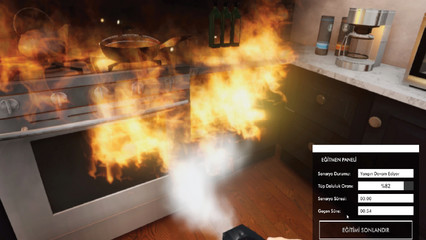
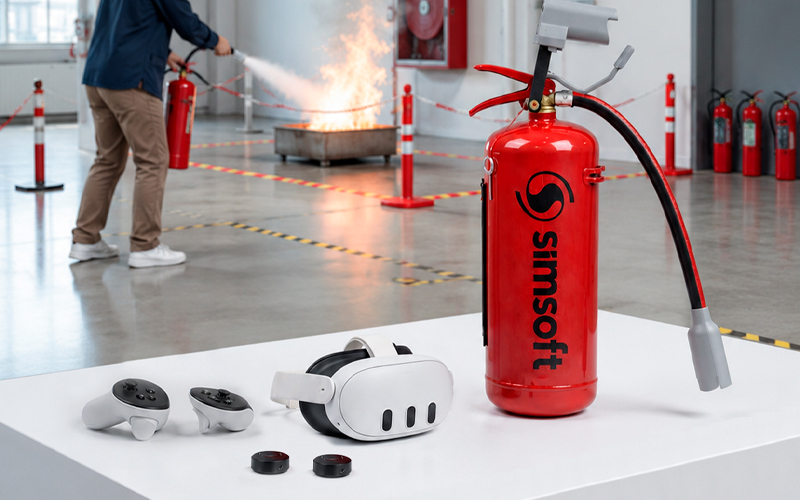
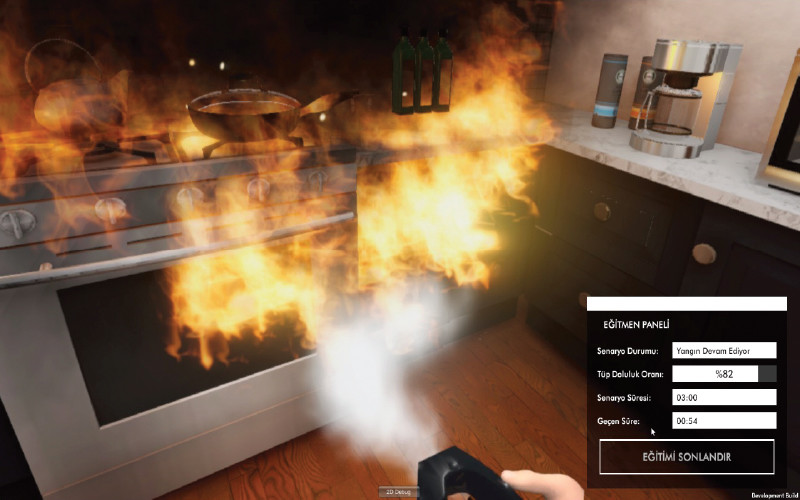
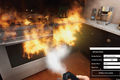
The FIREVR Fire Extinguishing Training Simulator is an interactive virtual reality simulation we developed to provide realistic, operational-level training for responding to Class A, B, and F fires.
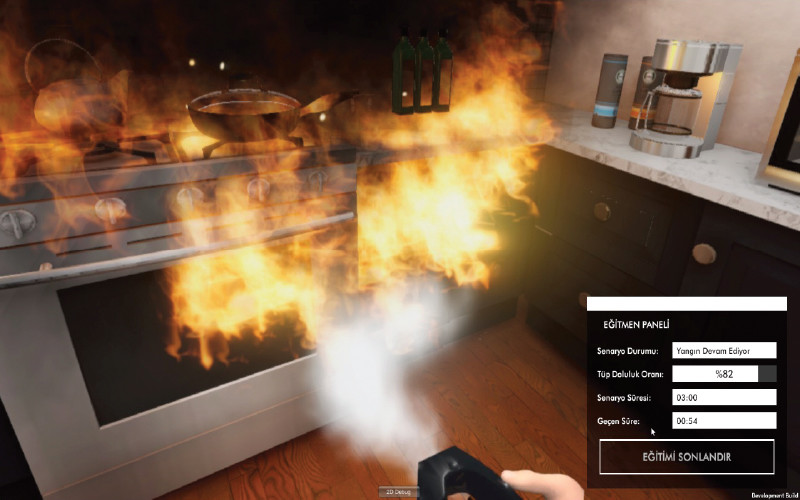
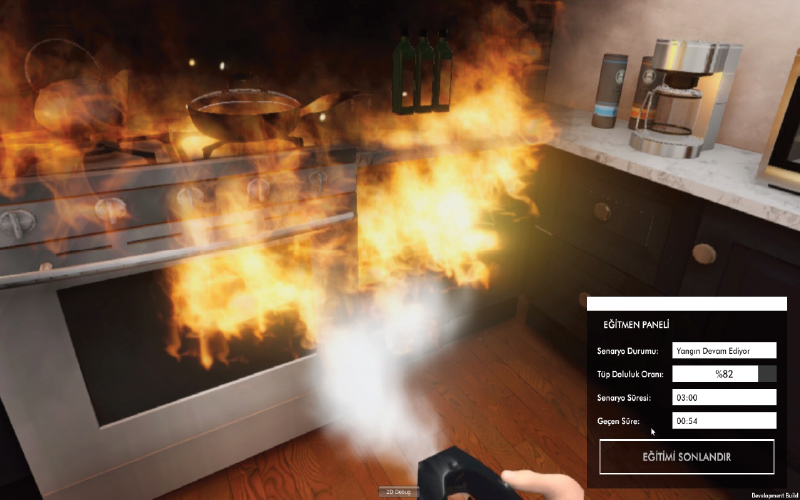
FIREVR goes beyond the visual representation of fire. Fire type, combustible material, and oxygen concentration are incorporated into the physical modeling of the simulation. Users respond to simulated fires using virtual or physical fire extinguishers while practicing procedures such as selecting the appropriate extinguisher for the fire class, operating the fire alarm, emergency evacuation, and electrical power shutoff.
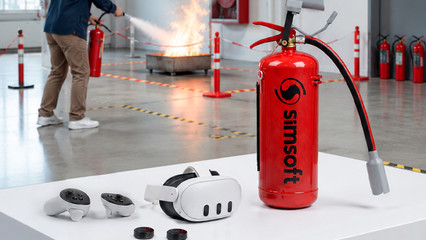
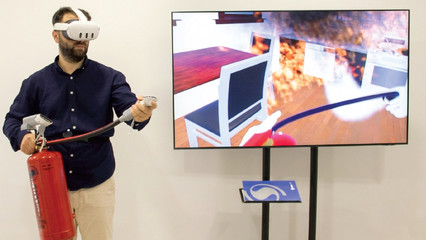
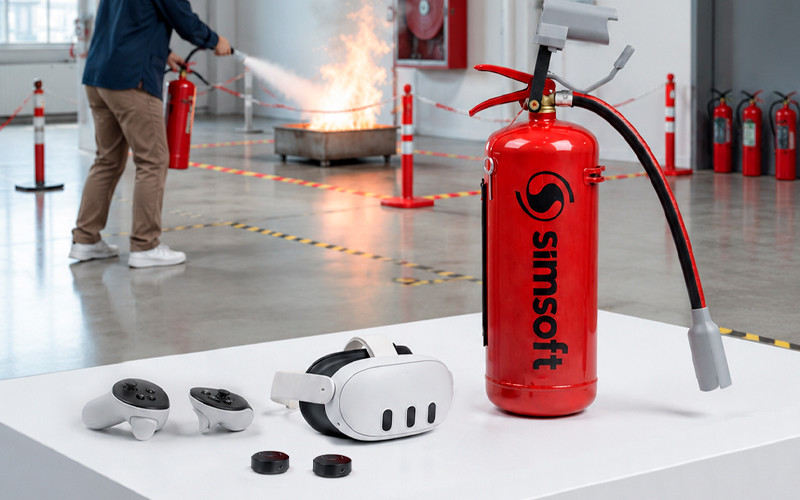
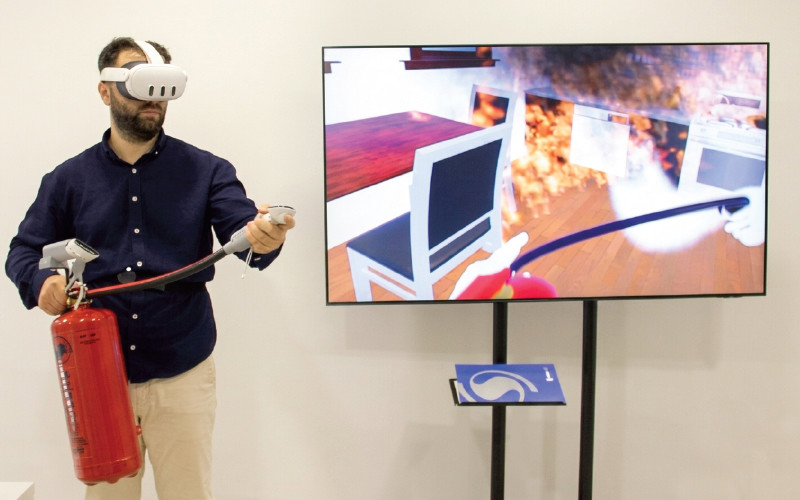
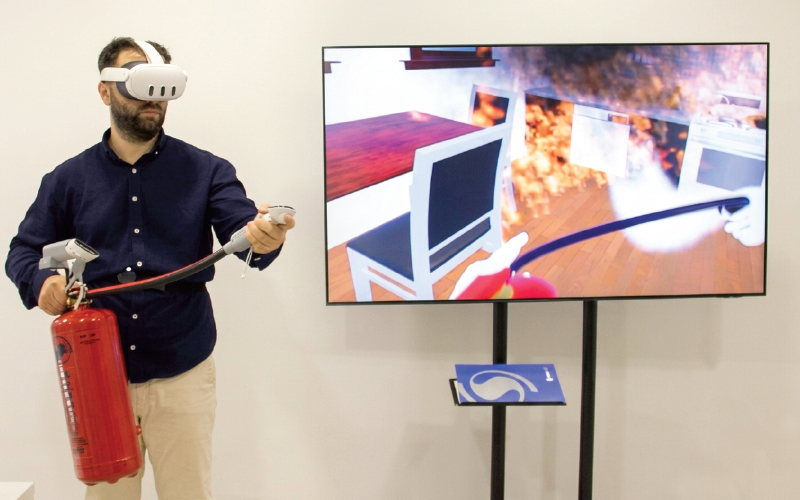
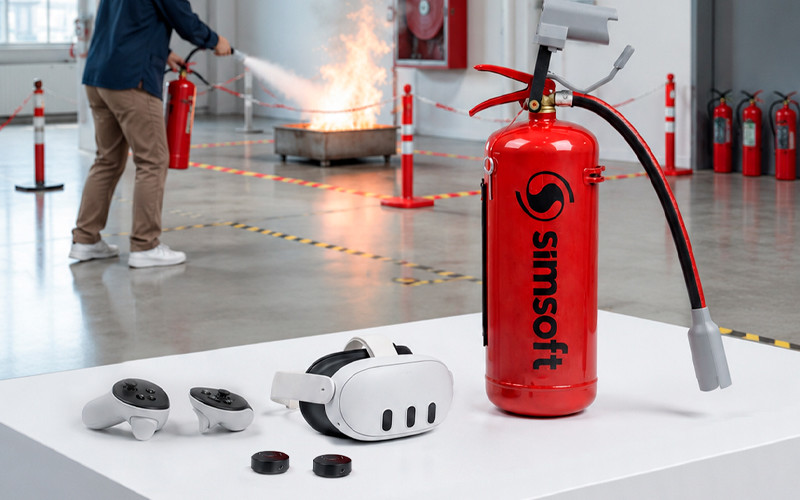
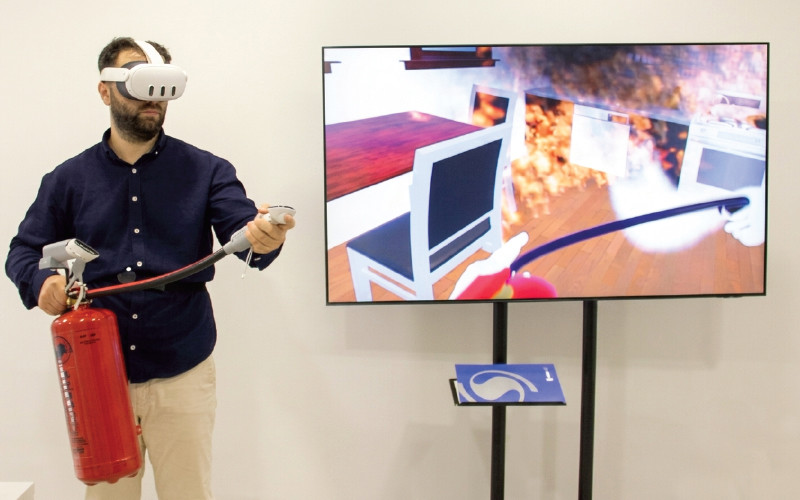
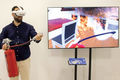
The system can be configured with different hardware and interaction options, ranging from VR headsets and controllers to motion sensor-enabled physical fire extinguishers, hand tracking, CAVE systems, and large-screen visualization.
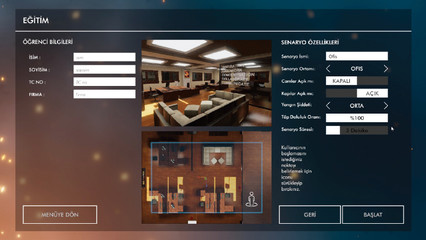
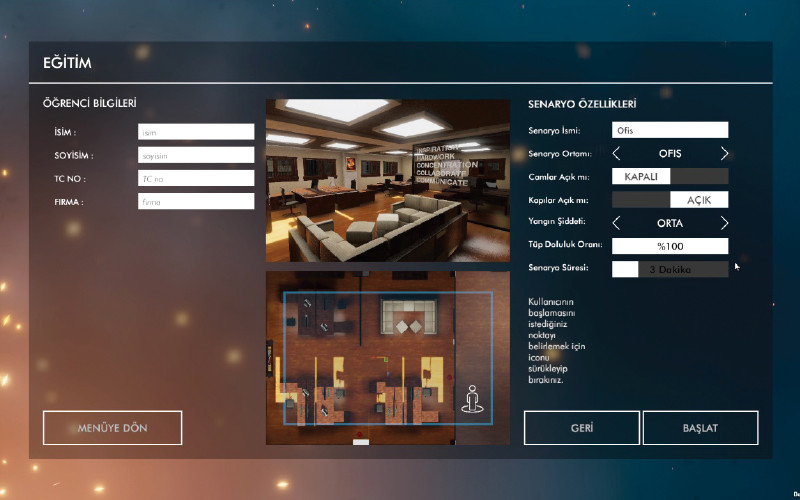
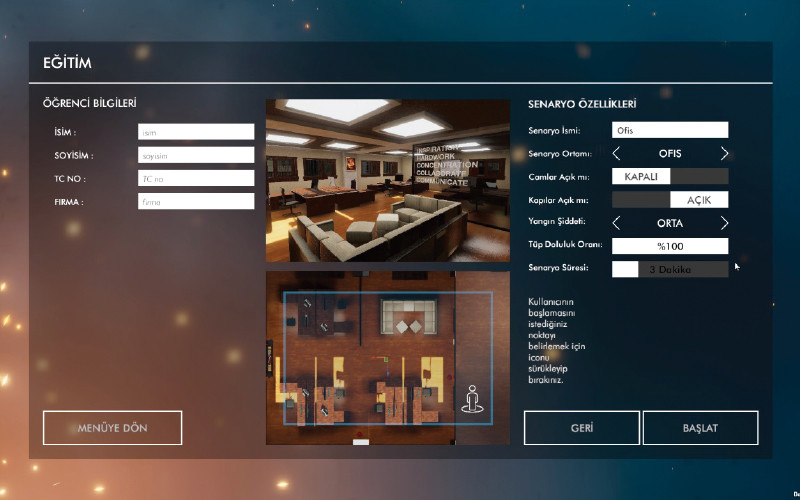
During training, user performance can be evaluated based on contacting emergency services, following the correct response procedures, intervention distance, and response time.
Application Areas
FIREVR is developed for training environments where users need to recognize fire hazards, select the appropriate fire extinguisher, and practice fire response procedures through interactive simulation.
The system can support:
- Occupational health and safety training
- Corporate fire safety training
- Employee training in industrial facilities
- Emergency response and fire safety training
- Vocational and technical training applications
- Scenario-based fire safety training

Detailed Information
Photos
Videos
Core Capabilities
Modeling of Class A, B, and F Fires
The FIREVR simulation infrastructure incorporates the characteristics of different fire classes into the training environment.
Class A Fires
Fires involving ordinary solid combustible materials that burn and form embers, such as wood, paper, fabric, coal, and plastics.
Class B Fires
Fires involving flammable liquids or liquefiable solids, such as gasoline, thinner, diesel fuel, paint, and alcohol.
Class F Fires
Fires involving vegetable and animal cooking oils and fats used in deep fryers and cooking appliances.
This structure allows training to address not only extinguishing the fire, but also identifying the fire class and selecting the appropriate response method.
Physical Modeling
FIREVR models fire scenarios using three core physical parameters:
Fire Type
Defines the class and characteristics of the fire represented in the scenario.
Combustible Material
Incorporates the material involved in the fire into the physical model.
Oxygen Concentration
Uses the oxygen conditions within the fire environment as one of the simulation parameters.
Together, these parameters enable different fire conditions to be represented within the training scenario.
Multiple Interaction and Control Options
FIREVR can be configured with different interaction methods according to the training environment and intended use.
The system supports:
- Virtual fire extinguisher and virtual environment
- Physical fire extinguisher
- Motion sensor-enabled physical fire extinguisher
- Hand tracking and controller support
- Movement within the virtual environment using locomotion sensors
This enables user interaction to range from a fully virtual configuration to setups incorporating physical equipment and motion tracking.
Fire Suppression in Different Environments
Fire response conditions can vary considerably according to the environment. FIREVR therefore extends training beyond a single virtual setting.
Fire suppression scenarios can be conducted in:
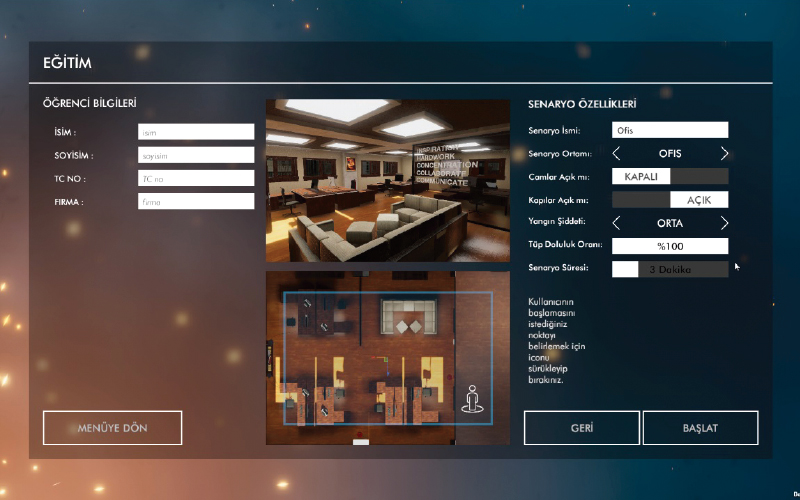
- Office
- Workshop
- Kitchen
- Fuel Station
This allows different environmental conditions and fire sources to become part of the training scenario.
Training and Usage Structure
FIREVR training is not limited to the act of extinguishing a fire. Different stages—from assessing the fire and selecting the appropriate equipment to performing the intervention and following emergency procedures—can be practiced within the scenario.
Basic Fire Extinguisher Operation
Users practice fire extinguisher operation using virtual or physical equipment. Depending on the selected system configuration, interaction can be provided through controllers, hand tracking, a physical fire extinguisher, or motion sensors.
Fire Extinguisher Selection Based on Fire Class
Users assess the type of fire encountered and select the appropriate fire extinguisher according to the fire class.
This extends the training beyond equipment operation to include situation assessment and selection of the appropriate response equipment.
Emergency Procedures
Training scenarios can also incorporate:
- Fire alarm operation
- Emergency evacuation
- Electrical power shutoff
- Contacting emergency services
This allows users to practice different response and safety procedures within the same scenario flow.
Technology and Infrastructure
The FIREVR technical architecture can be configured with different hardware components according to the training objective and installation environment.
Configurable Hardware Components
- VR headset and controllers
- Fire extinguisher model
- Motion sensors
- CAVE system
- Projection screen system
- Large-screen visualization
The interaction architecture can incorporate a virtual fire extinguisher, physical fire extinguisher, motion sensors, hand tracking, controller support, and locomotion sensors.
This enables FIREVR to support different training and visualization configurations rather than being limited to individual VR headset use.
Value for Users and Organizations
Effective fire response requires more than knowing how to operate an extinguisher. Users must be able to assess the type of fire, select the appropriate extinguisher, and apply the correct response procedures.
FIREVR brings this process into a scenario-based training environment.
Users can practice response procedures across different fire classes and environments, while the system enables the correct sequence of actions and intervention performance to be evaluated.
Its configurable hardware architecture also allows organizations to structure the training environment using different combinations of VR, physical equipment, motion tracking, CAVE systems, and large-screen visualization.
Customization and Integration
Fire training requirements vary according to the target users, working environment, and intended training scenarios.
The configurable architecture of FIREVR enables both user interaction methods and visualization infrastructure to be adapted to different requirements.
Training can be configured as a fully virtual experience using a virtual fire extinguisher or enhanced with physical interaction through a physical fire extinguisher, motion sensors, and hand tracking.
VR headsets, CAVE systems, projection screen systems, and large-screen visualization options allow the system to be configured for different training spaces and installation requirements.
Simsoft Engineering Approach
The value of virtual reality in fire extinguishing training goes beyond placing the user inside a three-dimensional environment. An effective training simulation must connect the physical characteristics of fire, user interaction, correct response procedures, and performance assessment within the same scenario.
We developed FIREVR around this integrated simulation approach.
We combine physical modeling based on fire type, combustible material, and oxygen concentration with Class A, B, and F fire scenarios, multiple interaction methods, configurable hardware infrastructure, and measurement and evaluation capabilities.
As a result, FIREVR provides more than a virtual representation of a fire. It creates an interactive training environment in which users assess the fire, select the appropriate response method, perform the required procedures, and have their performance evaluated.